By: Dr. Faisal Amri Tanjung, MT
Plastic waste has been a major environmental problem since the third industrial revolution several decades ago. This waste amounts to around 10-11% of total world waste; therefore, management of plastic waste will require several complementary treatments. Biodegradable plastic technology is considered a solution to overcome this problem, mainly because of its proven history of success. One commercial biodegradable plastic is polylactic acid (PLA). This bioplastic is a transparent polymer that is synthesized either by lactic acid condensation polymerization or by ring opening polymerization of lactide (cyclic dimers of lactic acid). Lactic acid is produced by chemical synthesis or by fermentation of carbohydrates such as starch, glucose, and xylose. PLA has desirable physical properties such as high melting point (175 ° C), high strength, and ease of processing. PLA is currently used in a large number of fields, including in agriculture, biomedicine, and packaging, demonstrating good potential to replace plastics that cannot be biodegradable. However, the PLA market is limited due to high production costs and relatively weak mechanical properties.
PLA bioplastics with natural fibers have now been developed to reduce the cost of producing PLA materials through the incorporation of cheap fibers and also to increase the strength of materials and modules due to the reinforcing effect of natural fibers. However, these natural fibers are so hydrophilic that they can inhibit the fiber-polymer interaction due to poor compatibility at the interface. This problem is often overcome by chemical treatment of fibers or by the addition of polymers that function in the bioplastic system. Most of these chemical treatments aim to adjust the compatibility of the hydrophilicity of the fiber with the polymer to help wetting the polymer. Some chemical treatments covalently bind the two components together or add surface roughness to the fiber to help mechanically interlock.
Much research has been done on biodegradation and biodegradability of PLA bioplastics, with particular emphasis on degradation using microbes and enzymatics. Proteinase K from Tritirachium album , subtilisin, microbial serine protease has been used in PLA biodegradation. Some serine proteases from mammals such as α-chymotrypsin , trypsin , and elastase have also been used to degrade PLA. Among the known enzymes is diastase , the hydrolase enzyme classwhich is widely distributed in microbes, plants, and animals that have been proven to degrade starch-based materials through the hydrolytic mechanism. Diastases are a group of starch digesting enzymes which include α- and β-amylase . The α-amylase enzyme hydrolyzes the starch chain to produce various dextrins, and β-amylase divides the reducing sugar maltose from the end of the starch chain. Starch degradation mainly occurs in ester bonds along chain molecules. PLA consists of ester bonds, hence biodegradation occurs in ester bonds along the molecular chain.
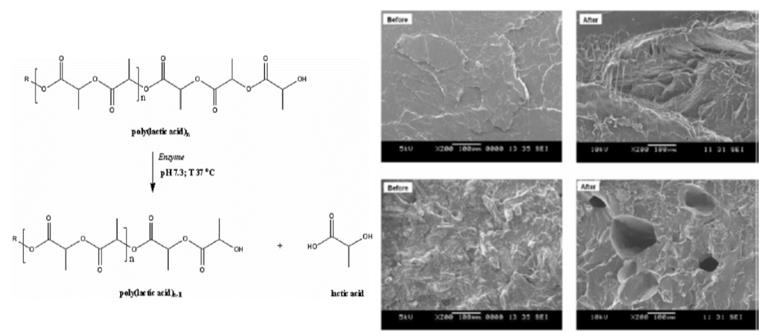
Figure: Schematic before and after degradation of Polylactic Acid.
Sources: Faisal Amri Tanjung, Yalun Arifin, and Salmah Husseinsyah. Enzymatic degradation of coconut shell powder reinforced polylactic acid biocomposites. Journal of Thermoplastic Composite Materials , 1–17, DOI: 10.1177 / 0892705718811895.
Versi Indonesia